Car battery Ah vs CCA: which number starts your engine in winter
What 60Ah and 540A on a car battery mean, why it loses power in the cold, which figures your engine needs and how to check it with a voltmeter before winter.
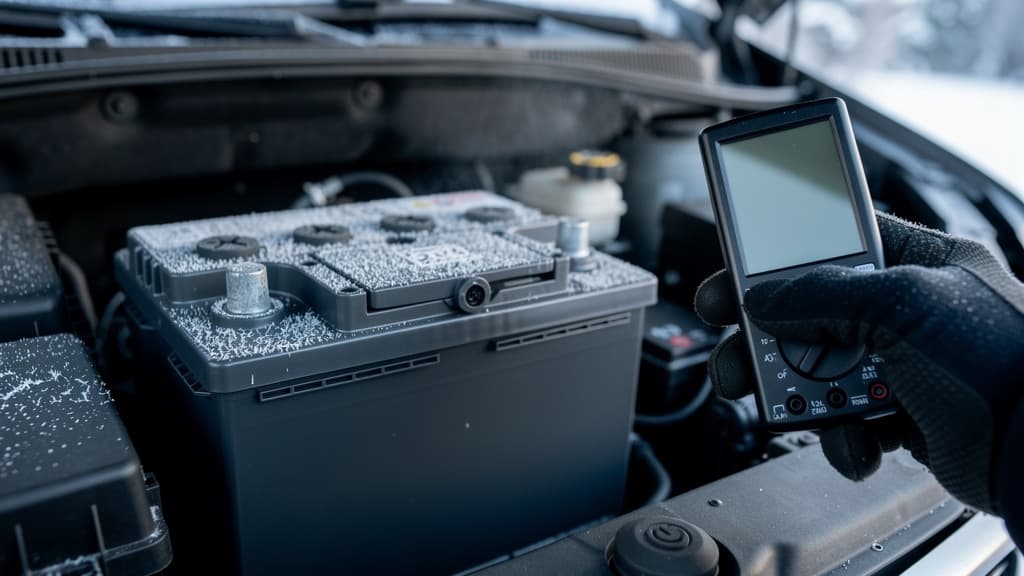
A car battery label carries two numbers: 60Ah and 540A. The first is capacity, the second is cold cranking current, and on a frosty morning it is the second one that starts the engine. Here is what each means, why a battery loses power in the cold and how to check yours before winter.
What Ah means
Ampere-hours (Ah) is capacity measured over a 20-hour discharge (C20): a 60Ah battery delivers 3 amps for 20 hours. It matters when the car is parked with the stereo or the alarm running. It has little to do with starting.
What A (EN) and CCA (SAE) mean
Cold cranking current shows how many amps the battery can deliver at -18 °C. Under the European standard (EN 50342-1) the battery is held at -18 °C for 24 hours, then discharged at the labelled current for 10 seconds while the voltage must stay above 7.5 V. The American SAE J537 test runs for 30 seconds at the same temperature with a 7.2 V floor. That is why the SAE figure on the same battery is often higher than the EN one. The old German DIN figure is roughly 60 percent of EN.
Standard | Temperature | Duration | Minimum voltage |
|---|---|---|---|
EN 50342-1 | -18 °C | 10 s | 7.5 V |
SAE J537 (CCA) | -18 °C | 30 s | 7.2 V |
Why batteries die in winter
According to AAA, a battery loses about 35 percent of its power at 0 °C and up to 60 percent at -18 °C. At the same time the engine needs 1.5 to 2.5 times more current to turn over in thick oil (we have a separate article on oil grades). In summer a 400-amp battery starts the car easily. On a Gudauri morning the same battery barely delivers 160 amps while the engine asks for twice as much. That is why a battery dies on the first frost, not in July.
Which figures you need
Engine | Capacity | Cold current (EN) |
|---|---|---|
1.4 to 1.8 petrol | 45 to 60 Ah | 400 to 600 A |
2.0 to 2.5 petrol, small diesel | 60 to 75 Ah | 600 to 700 A |
3.0 diesel, large SUV | 70 to 100 Ah | 700 to 900 A |
More cold current in the same case size never hurts. Less makes the starter work harder and leaves you stranded in winter. A car with start-stop must not get an ordinary battery: it needs an EFB or AGM unit, otherwise the new battery is finished within months.
How to check it
After a night's rest, before starting the engine, put a voltmeter on the terminals:
12.6 to 12.7 V: fully charged.
12.4 V: about 75 percent.
12.2 V: 50 percent.
12.0 V: 25 percent, charge or replace it before winter.
Heat damages a battery, winter only exposes it. AAA puts the usual service life at 3 to 5 years, shorter in hot climates. Have any battery older than 3 years tested in November, at a workshop or with a simple tester.
Frequently asked questions
Can I fit a battery with more amps?
Yes, if the case size and terminals match. More cold current makes the starter's job easier, and the alternator only charges as much as the battery accepts.
What do 60Ah and 540A on a battery mean?
60Ah is the capacity over a 20-hour discharge. 540A is the current the battery delivers at -18 °C for 10 seconds under the European standard.
How long does a car battery last?
Three to five years on average. Heat, long periods of standing and frequent short trips shorten that.
Max
Tags
Please sign in to leave a comment
Sign inNo comments yet. Be the first to comment!