Warming up the engine in winter: how long, and why idling hurts
What Hyundai, BMW, Toyota and VW manuals say, what happens inside a cold engine at idle, what the ADAC test at -10 °C showed and how to drive off the right way.
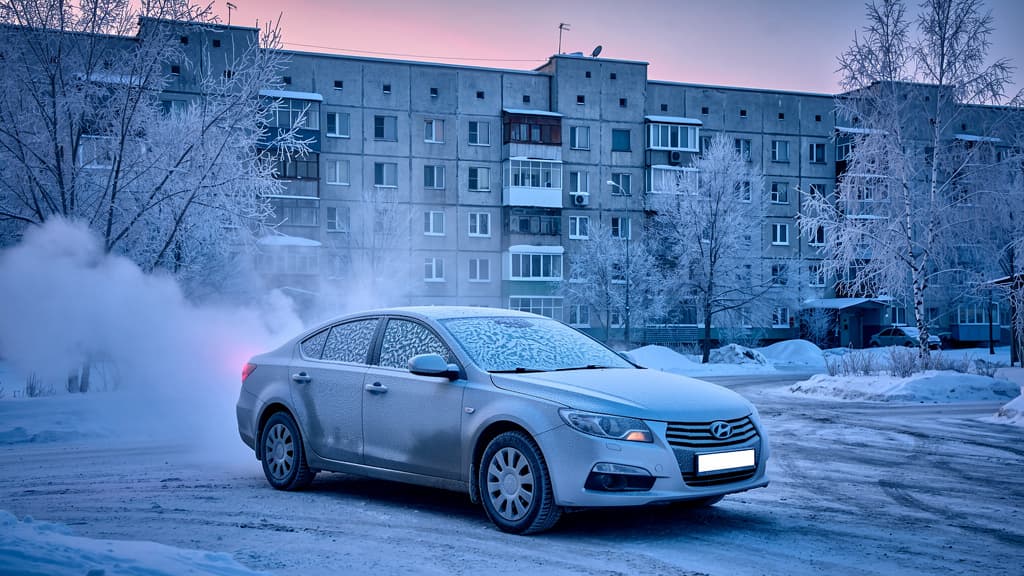
Warming the engine at idle on winter mornings is a habit all over Georgia: ten cars sit in the courtyard and steam. A modern fuel-injected engine does not need it, and in some ways it suffers from it. Here is what the manufacturers, the engineers and the measurements say.
What the manufacturers write
Manufacturer | Advice from the owner's manual |
|---|---|
Hyundai, Kia | Do not wait for the engine to warm up while the vehicle is stationary, start driving at moderate engine speeds |
BMW | Do not let the engine warm up while stationary, driving is the fastest way to reach operating temperature |
Volkswagen | Clear the windows first, then drive off right away |
Toyota | In very cold weather wait some dozens of seconds for the oil to circulate, then drive gently |
Ford | Do not idle for more than 30 seconds, older carburetted cars needed warm-up time |
All five say the same thing: start, drive off within seconds and take the first kilometres gently.
What happens inside a cold engine at idle
A cold engine runs rich, that is, it injects more fuel than usual until the cylinder walls warm up. Stephen Ciatti, an engineer at Argonne National Laboratory, explains that petrol is an excellent solvent and washes oil off the cylinder walls, so wear goes up while the car sits. Part of that fuel ends up in the oil. Manufacturers admit this on direct-injection engines: a 2018 Mazda service bulletin explains a rising oil level by frequent cold running.
In an ADAC test at -10 °C the oil had warmed only to -7 °C after four minutes of idling, and the cabin was at 13 °C. At idle an engine takes around 20 minutes to reach operating temperature. On the move it gets there several times faster.
The catalytic converter and the fines
A catalytic converter does nothing until it reaches about 250 °C, which is why 50 to 80 percent of a city's harmful emissions come from cold starts. Germany bans idling for that reason, and the fine is 80 euros. Natural Resources Canada calculates that 10 minutes of idling burns 0.25 to 0.5 litres of fuel.
Where the habit comes from
A carburetted engine really did need a warm-up: without it the cold mixture stalled. Fuel injection and the lambda sensor have been metering the mixture on their own for more than 30 years. The habit was handed down from our fathers.
The right way
Clear the windows before starting or right after.
Drive off within 30 to 60 seconds. On a turbo engine Hyundai advises a few seconds after starting so the turbocharger gets oil.
Take the first kilometres at moderate revs without full throttle until the temperature needle reaches the middle.
At -20 °C and on a diesel a minute or two more does no harm. Ten minutes gives nothing.
Frequently asked questions
How long should I warm up the engine in winter?
30 to 60 seconds is enough. Then drive off and take the first kilometres gently, the engine warms faster on the move.
Does driving off cold damage the engine?
No, if you drive gently. What damages it is full throttle on a cold engine and long idling on a rich mixture.
What about turbo and diesel engines?
The same rule, with a few extra seconds after starting and more care over the first kilometres until the oil is warm.
Max
Tags
Please sign in to leave a comment
Sign inNo comments yet. Be the first to comment!